Harmo Brain Official Website / Benefits
What it is made to supportHarmo Brain Benefits: What a Brain Energy Capsule Offers
Harmo Brain is made to support brain energy, and its benefits start with what is in it: 80 mg of magnesium, 19% of the Daily Value, plus CoQ10, alpha lipoic acid and L-carnitine, three nutrients the body uses inside mitochondria to make energy. A circulation botanical and turmeric extract complete the blend, in one capsule a day with a 60-day guarantee.
Below: six label-based benefits, the seller’s artwork lines, buyer reports and the limits.
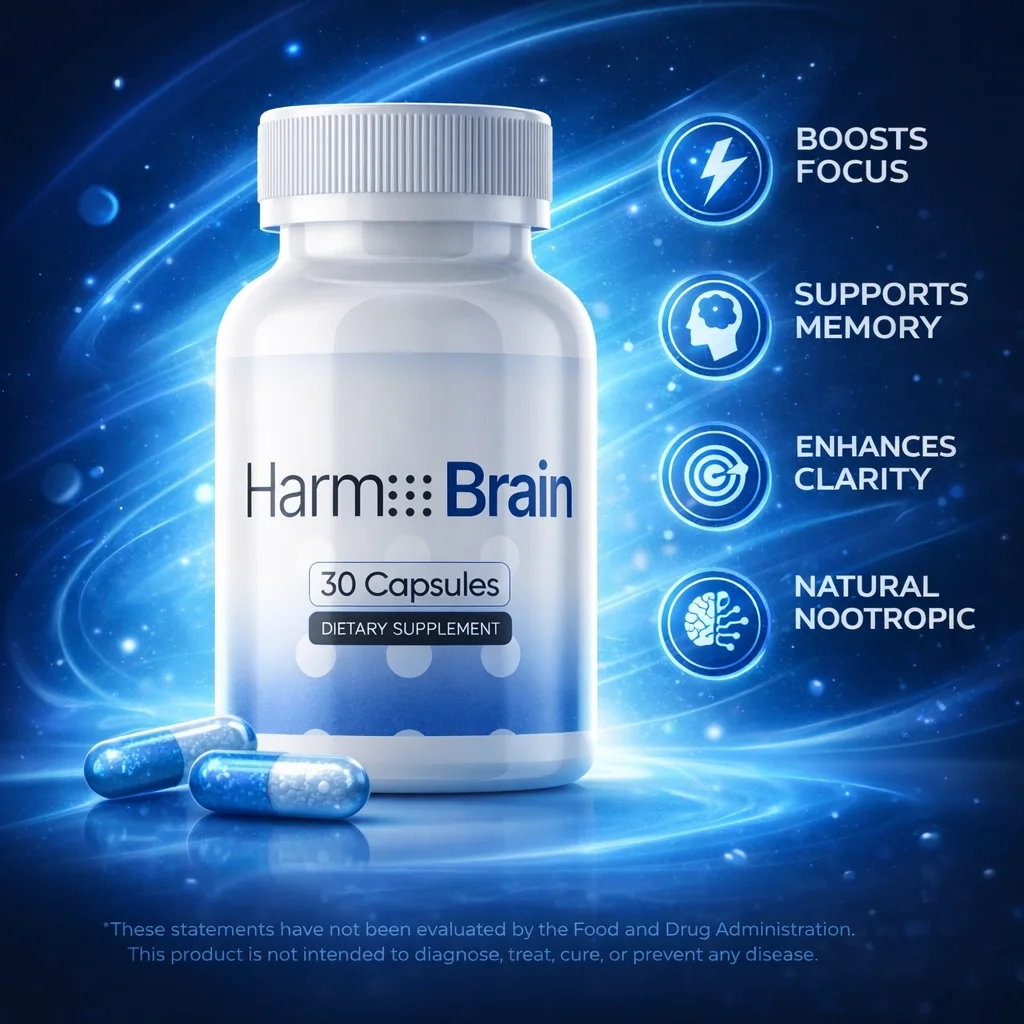
Harmo Brain benefits, one per line of the panel
Each benefit below comes from something printed on the bottle, not from a promise about outcomes.
A real share of your daily magnesium
80 mg is 19% of the Daily Value, from a form bound to glycine. Magnesium is a cofactor in more than 300 enzyme systems, energy production among them (NIH ODS).
Three mitochondrial nutrients together
CoQ10, alpha lipoic acid and L-carnitine each have a job in the cell’s energy machinery, and you get all three from one capsule instead of three bottles.
A circulation botanical
Butcher’s broom root extract, used in European vein products for more than 50 years (Allaert), is the circulatory half of the formula.
A standardised turmeric extract
Standardised to 95% curcuminoids, so the extract is defined by the compounds its research is about, not by the weight of powdered root.
One capsule, once a day
Thirty capsules to a bottle and a one-line direction on the label. No timing rules, no mixing, no second dose to remember.
Sixty days to decide
Every pack carries a 60-day money-back guarantee from purchase, long enough to cover the four to eight weeks most buyers here describe.
Why Harmo Brain uses magnesium glycinate
Magnesium is the only ingredient on the panel with its own figure, so its form and its size are worth a closer look.
Why the glycinate form
Magnesium is sold in many forms, oxide and citrate among them. Glycinate is magnesium bound to glycine, an amino acid, and it is the form this panel names as the source of its 80 mg.
In a small absorption trial of 12 adults after ileal resection, magnesium diglycinate was absorbed as well overall as magnesium oxide, better in the poorest absorbers, and was better tolerated. That is a finding in people with a gut condition, but it is the reason the glycinate form has a gentle reputation. Large amounts of magnesium from supplements are known for loosening the bowel, which is why an upper limit exists at all (NIH ODS); 80 mg sits far below it.
How 80 mg fits into a day
Adults need 310 to 420 mg of magnesium a day from all sources, and most of it comes from food: leafy greens, nuts, seeds, beans and whole grains (MedlinePlus).
The 350 mg upper limit counts magnesium from supplements and medicines only, not food. One capsule therefore leaves 270 mg of room for any other magnesium supplement, and the magnesium in a multivitamin counts toward it.
What the Harmo Brain artwork says, and what the panel backs
The key visuals print four short lines. Here they are, next to the facts that sit behind them.
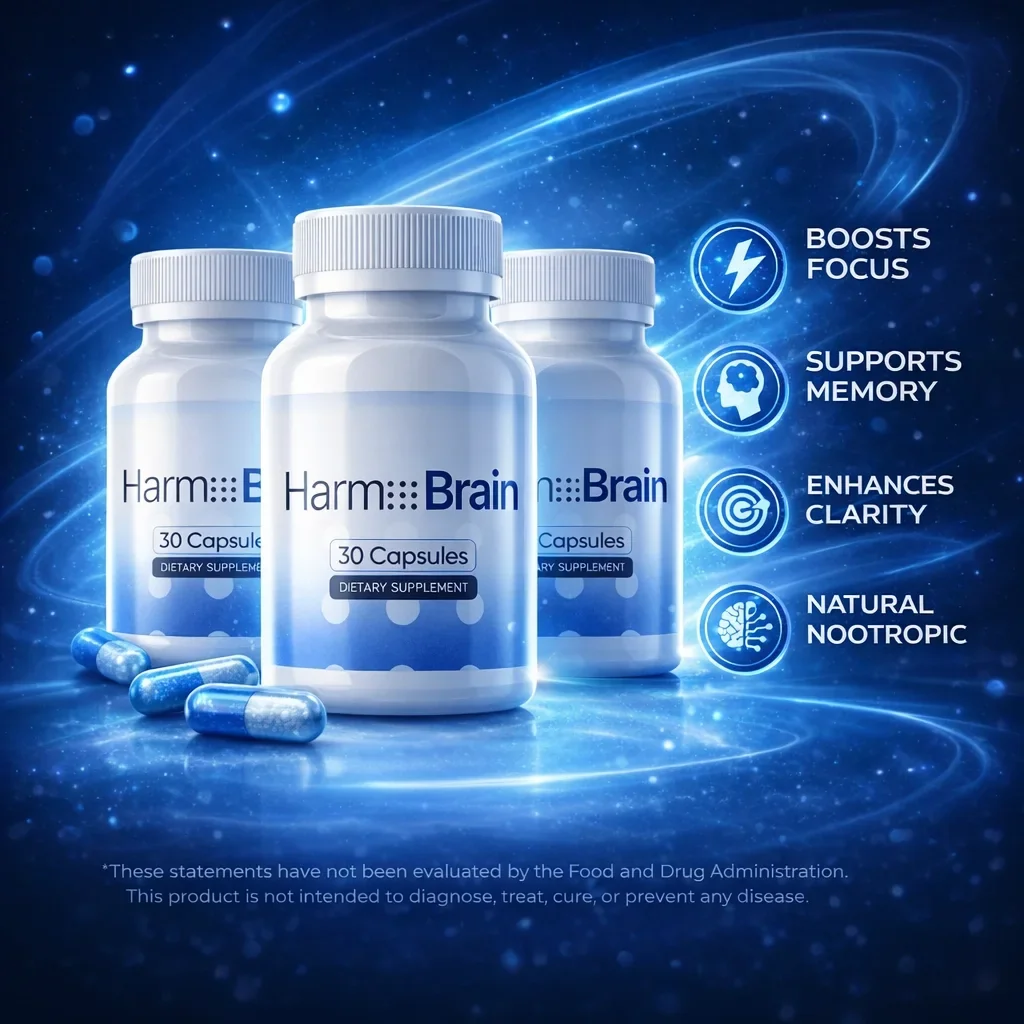
The seller’s key visuals print four lines beside the bottles: “Boosts Focus”, “Supports Memory”, “Enhances Clarity” and “Natural Nootropic”. They are the seller’s artwork. This website describes Harmo Brain by what its panel prints and by the supplier’s own phrase, a mitochondrial and circulatory formula.
Here is what the panel gives each line to stand on. Magnesium at 80 mg, a mineral with a documented role in nerve transmission (Kirkland and colleagues). Three mitochondrial nutrients, in an organ that depends heavily on mitochondria (Picard and McEwen). And a turmeric extract, whose best-known memory trial used a bioavailable curcumin at 90 mg twice a day for 18 months in 40 adults aged 51 to 84 without dementia (Small and colleagues).
What none of that is: a test of this capsule. The four lines describe what the seller hopes buyers notice. Whether you do is what the 60-day window is for.
Harmo Brain benefits as this desk’s buyers describe them
Numbers from this desk’s own order records, with the dislikes printed beside the likes.
Those are this desk’s own order records, not a trial, and they describe the people who bought here. What buyers liked most was the single daily capsule, and the 60-day window; what they liked least was a slow start, and wanting more in the first week. Seven of the eight reviewers on the published roster say the capsule became a daily habit and they reordered before the last bottle ran out.
The one three-star reviewer wanted a faster change, called order support and stopped at two bottles, inside the guarantee window. Both kinds of story are on the reviews page in full.
Getting the most from Harmo Brain day to day
The benefits of a daily capsule depend on the daily part. Three habits make them easier to notice.
Anchor it to a meal
CoQ10 is fat-soluble (Bhagavan and Chopra), so a meal you never skip is a sensible anchor. The label sets one capsule daily and leaves the hour to you.
Keep the rest of the day steady
Sleep, movement and staying socially engaged are the habits the National Institute on Aging links with cognitive health. A capsule sits beside them, not in place of them.
Judge it on a written baseline
Note sleep, afternoon energy and focus on day one, then look again at week four and week eight. A slow change is easy to miss without a record.
- Take it at the same point in the day, every day.
- Keep coffee, sleep and exercise roughly as they were, so you can tell what changed.
- Count any other magnesium supplement: the supplement ceiling for adults is 350 mg a day (NIH ODS).
- Give it at least four weeks before drawing a conclusion.
What Harmo Brain benefits do not include
A benefit list is only useful if it has edges. Here they are.
What the label supports
- A daily source of magnesium: 80 mg, 19% of the Daily Value
- Three nutrients with defined jobs in mitochondria, in one capsule
- A circulation botanical and a standardised turmeric extract
- A 60-day money-back window on every pack
What it is not
- Not a treatment for any condition, and not a substitute for care
- Not a stimulant: nothing on the panel works like caffeine
- Not backed by a finished-product trial cited here
- Not a replacement for sleep, food or activity
Harmo Brain is a dietary supplement. The benefits above describe what its ingredients are and do in the body, which is the kind of statement the FDA calls a structure/function claim; they are not promises about how anyone will feel.
Harmo Brain benefits: questions
What are the benefits of Harmo Brain?
It is made to support brain energy. Each capsule gives 80 mg of magnesium, 19% of the Daily Value, with three mitochondrial nutrients (CoQ10, alpha lipoic acid, L-carnitine), a circulation botanical and a standardised turmeric extract, once a day, with a 60-day guarantee.
What does brain energy mean on this website?
It is the plain-language name for the supplier’s own description, a mitochondrial and circulatory formula: nutrients the body uses to make energy inside cells, plus a circulation botanical. It describes what is in the capsule, not a promised feeling.
Has Harmo Brain been tested in a clinical trial?
No trial of the finished capsule is cited on this website. Each of its six materials has its own research record, mostly at larger daily amounts and often in people with a diagnosis, and those results stay with the people studied.
Who gets the most out of Harmo Brain?
Healthy adults who want a single daily capsule, are happy to judge it over weeks, and keep a simple record of how they feel. The who it is for page has a self-check.
Can I take Harmo Brain with a multivitamin?
Check the multivitamin’s magnesium first: add it to the 80 mg here and keep the total from supplements under 350 mg a day. If another product also holds turmeric, CoQ10 or lipoic acid, count those too, and read the safety page if you take any medicine.
Will Harmo Brain work for me?
Nobody can promise that, and individual results vary. The 60-day money-back guarantee from purchase exists so you can find out without the whole cost riding on it.
Who writes the Harmo Brain benefits page
How these pages are checked
- The bottle is the source. The six materials, the two amounts, the capsule count, the suggested use and the caution come from the printed label and its Supplement Facts panel. Contacts, the guarantee and the refund route come from this desk.
- Research amounts live in a column of their own, headed “What published research used or found”, beside a column that says what this label prints. No sentence here moves a number from the first into the second.
- Sources are cited against their own population. Where a trial was run in people with a diagnosis, the sentence says so and the result is not carried across to a healthy reader.
- Corrections change the date. Write to contact@Harmoebrain.com and the review date moves forward.
Why we say where we earn
Harmoebrain is the USA Authorized Harmo Brain Retailer named at the top of this page, and this website earns on orders placed through it. That is why the label arithmetic, the three-star review and the medication notes are printed here in full: they are where our interest and yours could pull apart.
Order support on +1 (302) 200-3480 handles tracking, changes and refunds and is never a way to place an order; orders go through the checkout only.
Sources behind the Harmo Brain benefits
- NIH Office of Dietary Supplements. Magnesium: Fact Sheet for Health Professionals. https://ods.od.nih.gov/factsheets/Magnesium-HealthProfessional/
- MedlinePlus Medical Encyclopedia. Magnesium in diet. U.S. National Library of Medicine. https://medlineplus.gov/ency/article/002423.htm
- Kirkland AE, Sarlo GL, Holton KF. The Role of Magnesium in Neurological Disorders. Nutrients. 2018;10(6):730. PMID 29882776. https://pubmed.ncbi.nlm.nih.gov/29882776/
- Schuette SA, Lashner BA, Janghorbani M. Bioavailability of magnesium diglycinate vs magnesium oxide in patients with ileal resection. JPEN J Parenter Enteral Nutr. 1994;18(5):430-5. PMID 7815675. https://pubmed.ncbi.nlm.nih.gov/7815675/
- Allaert FA. Combination of Ruscus aculeatus extract, hesperidin methyl chalcone and ascorbic acid: a comprehensive review of their pharmacological and clinical effects and of the pathophysiology of chronic venous disease. Int Angiol. 2016;35(2):111-6. PMID 26928296. https://pubmed.ncbi.nlm.nih.gov/26928296/
- Small GW, Siddarth P, Li Z, et al. Memory and Brain Amyloid and Tau Effects of a Bioavailable Form of Curcumin in Non-Demented Adults: A Double-Blind, Placebo-Controlled 18-Month Trial. Am J Geriatr Psychiatry. 2018;26(3):266-277. PMID 29246725. https://pubmed.ncbi.nlm.nih.gov/29246725/
- Bhagavan HN, Chopra RK. Coenzyme Q10: absorption, tissue uptake, metabolism and pharmacokinetics. Free Radic Res. 2006;40(5):445-53. PMID 16551570. https://pubmed.ncbi.nlm.nih.gov/16551570/
- Picard M, McEwen BS. Mitochondria impact brain function and cognition. Proc Natl Acad Sci U S A. 2014;111(1):7-8. PMID 24367081. https://pubmed.ncbi.nlm.nih.gov/24367081/
- National Institute on Aging. Cognitive Health and Older Adults. National Institutes of Health. https://www.nia.nih.gov/health/brain-health/cognitive-health-and-older-adults
- U.S. Food and Drug Administration. Structure/Function Claims. https://www.fda.gov/food/nutrition-food-labeling-and-critical-foods/structurefunction-claims
See what Harmo Brain does for you
One capsule a day for four to eight weeks is the window most buyers here describe, and the 60-day guarantee from purchase covers all of it.
Pack prices are shown on the seller’s checkout before you pay · 60-day money-back guarantee from purchase · lot HAR-26/HA-3723