Harmo Brain Official Website / Reference Guides / Brain Energy Supplement Guide
GuideBrain Energy Supplement Guide: Mitochondria, Ingredients and What the Research Used
A brain energy supplement is a capsule built around nutrients involved in how cells make energy: CoQ10, alpha lipoic acid, L-carnitine and magnesium are the usual names, sometimes with a circulation botanical. Most of the research on them studied single ingredients at larger daily amounts, often in people with a diagnosis, so the amounts on a label decide what any one capsule can carry.
This guide covers the biology, the usual ingredients, the doses studied and how to read a label, with Harmo Brain as the worked example.
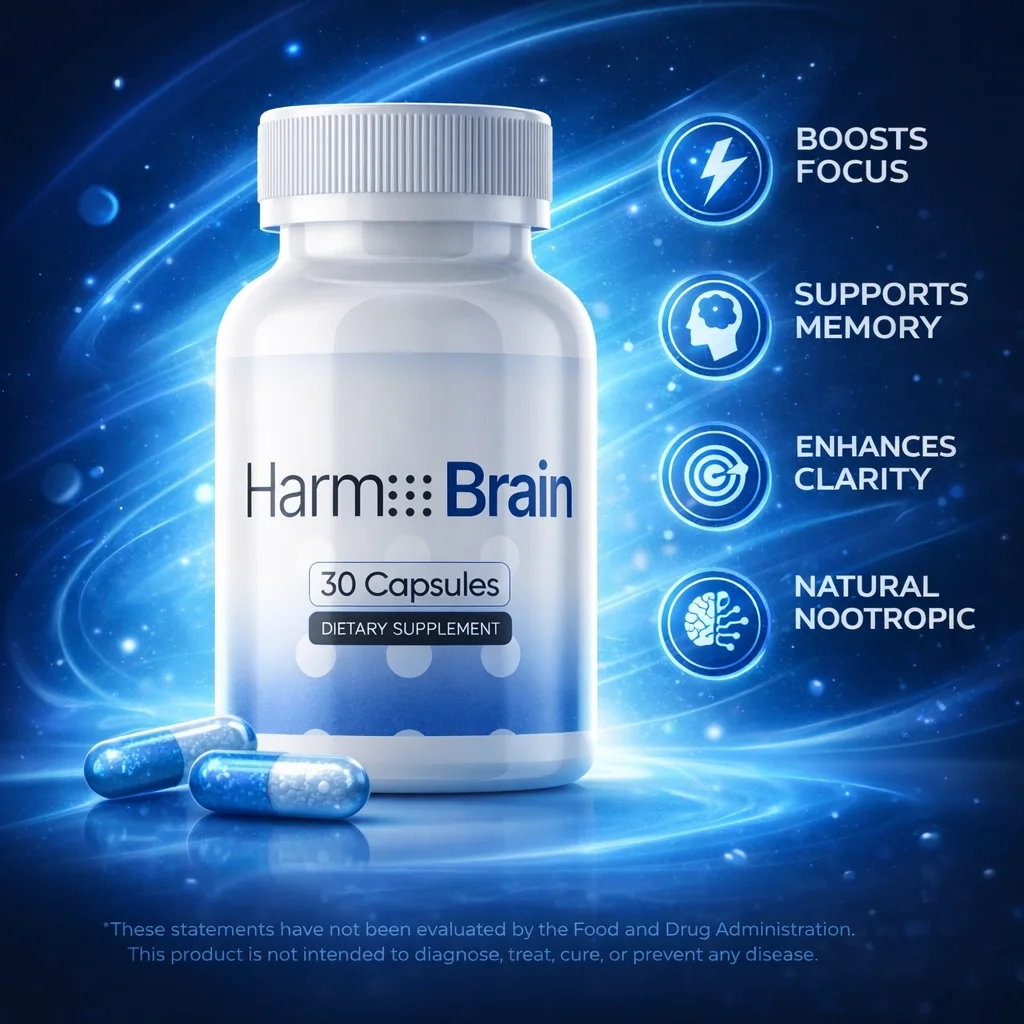
What brain energy means on a label
Two words on a label, and what they can and cannot mean.
A category, not a result
Brain energy is a category name, not a measured outcome. It gathers supplements built around nutrients that take part in how cells turn food into usable energy, on the reasoning that the brain is among the most energy-hungry organs in the body and depends on its mitochondria to meet that demand (Picard and McEwen).
What the biology leaves open is whether a capsule changes anything a person can notice. That depends on what is in it, and how much.
How labels describe it
Labels in this category describe themselves in structure/function language, and every such statement carries the FDA disclaimer (FDA rules on structure/function claims). The supplier of Harmo Brain, for example, calls it a mitochondrial and circulatory formula: three names on its panel serve mitochondria and one serves circulation.
Everyday habits still carry most of the weight: the National Institute on Aging puts physical activity, blood pressure, diet and social contact at the centre of cognitive health.
Mitochondria in four jobs
Four of the jobs mitochondria depend on map onto the four names most often found in this category.
The energy chain
Inside each mitochondrion, the electron transport chain turns fuel from food into ATP, the cell's energy currency. Coenzyme Q10 is part of that chain and is made in every cell (Hernandez-Camacho 2018).
Enzyme cofactors
Alpha lipoic acid is made in small amounts by the body and works as a cofactor for enzyme complexes inside mitochondria (Linus Pauling Institute).
The fuel shuttle
L-carnitine carries fatty acids into mitochondria so they can be burned for energy. The liver and kidneys make enough for most healthy adults (NIH ODS).
The mineral cofactor
Magnesium is a cofactor in more than 300 enzyme systems, and the body needs it for energy production (NIH ODS).
Each of these is made by the body or eaten in ordinary food, so the amount on the label matters more than the name.
The ingredients, and what each was studied for
One material per row, research on the left, label on the right.
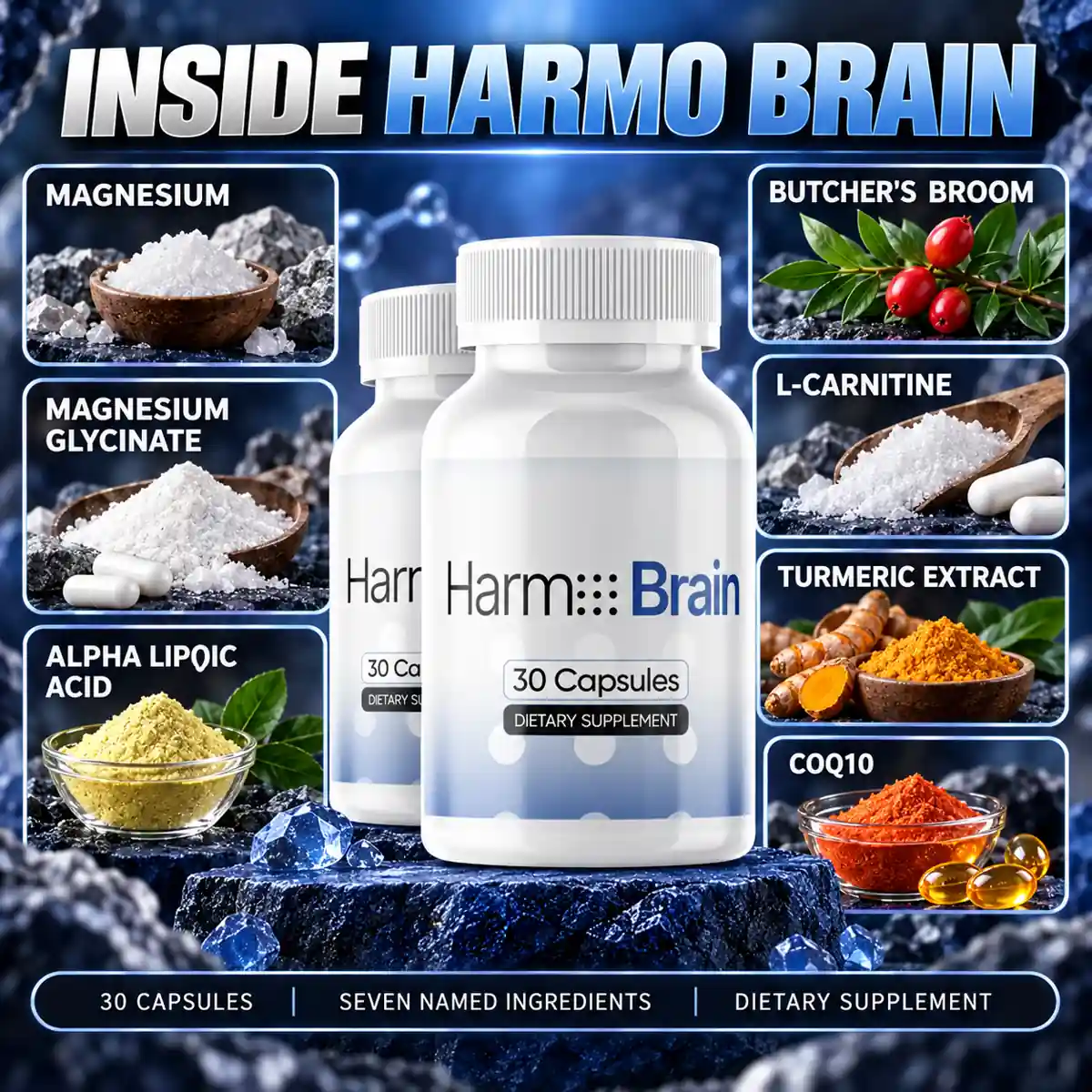
Four families on one panel
The Harmo Brain panel makes a useful worked example because its six materials come from four families: a mineral compound (magnesium glycinate), three mitochondrial nutrients (alpha lipoic acid, L-carnitine and CoQ10), a circulation botanical (butcher's broom) and a spice extract (turmeric).
The table sets each against the amounts published research used. The Harmo Brain panel prints magnesium at 80 mg and the six-ingredient blend at 575 mg in total, so no research figure here describes what one capsule holds.
The rows draw on the NIH magnesium fact sheet, a 2023 meta-analysis of alpha lipoic acid, a placebo-controlled ruscus trial, an L-carnitine trial in prefrail older adults, an 18-month curcumin trial and a Cochrane review of CoQ10.
| Ingredient | What published research used or found | What this label prints |
|---|---|---|
| Magnesium (as glycinate) | 310–420 mg a day from all sources for adults; 350 mg a day is the upper limit from supplements | 80 mg magnesium, 19% DV |
| Alpha lipoic acid | 600, 1,200 and 1,800 mg a day in ten trials (1,242 people) of diabetic polyneuropathy | Share of the 575 mg blend |
| Butcher's broom root extract | The German monograph’s recommended daily dose of a ruscus extract, 12 weeks, in women with chronic venous insufficiency | Share of the 575 mg blend |
| L-carnitine | 1.5 g a day for 10 weeks in prefrail older adults | Share of the 575 mg blend |
| Turmeric extract, 95% curcuminoids | 90 mg of curcumin twice a day, in a bioavailable form, for 18 months | Share of the 575 mg blend |
| Coenzyme Q10 (ubiquinone) | Two blood-pressure trials pooled by Cochrane, 50 people with primary hypertension, found no clinically significant effect; absorption peaks about six hours after a dose | Share of the 575 mg blend |
Several rows come from people with a diagnosis: diabetic polyneuropathy, chronic venous insufficiency, primary hypertension, prefrailty. The results stay with those groups.
Proprietary blends and what a panel can tell you
A blend hides the individual amounts and keeps the total and the order.
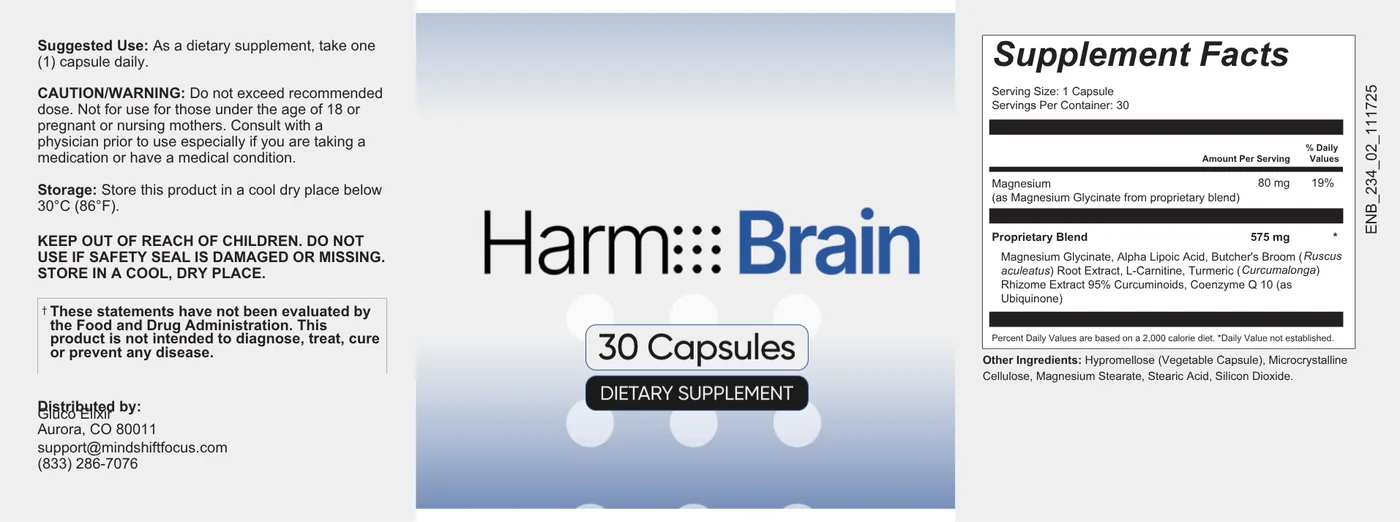
What a blend keeps, and hides
A Supplement Facts panel is laid out under a federal rule, 21 CFR 101.36. When ingredients are grouped as a proprietary blend, the panel gives the blend's total weight and lists its ingredients in descending order by weight, without the amount of each.
That still tells a careful reader a good deal. The first name is the heaviest and the last the lightest. A nutrient with a Daily Value gets its own row with an amount. And the blend total is a ceiling that every name inside it has to share.
On the Harmo Brain panel, the magnesium glycinate that delivers 80 mg of magnesium sits inside the 575 mg, so the other five names share what it leaves. The notebook works through that arithmetic in six ingredients share 575 mg.
Where a circulation botanical fits
One of the six materials is there for circulation, and its research is about the legs.
What the research measured
Butcher's broom (Ruscus aculeatus) is a perennial shrub native to the Mediterranean and Black Sea regions (Pacula 2025), and its root and rhizome extracts have been used in European vein products for more than 50 years (Allaert 2016). Its research sits in chronic venous insufficiency, a condition of the veins of the legs.
The placebo-controlled trial most often cited gave a ruscus extract at the German monograph's recommended daily dose for 12 weeks to women with chronic venous insufficiency: 166 enrolled, 148 analysed, and lower-leg volume fell against placebo (Vanscheidt 2002).
How to read it on a brain label
Those trials measured the legs. On a brain energy label, a circulation botanical is best read as the formula's circulatory half, as the supplier describes it, rather than as a demonstrated route to the brain. The notebook covers it in circulation on a brain label.
Absorption, the quiet variable
Two capsules with the same names can deliver very different amounts to the blood.
CoQ10 is slow
Fat-soluble and absorbed slowly: blood levels peak around six hours after a dose, with a half-life of about 33 hours (Bhagavan and Chopra).
Curcumin is poorly absorbed
Low absorption and rapid metabolism limit curcumin taken by mouth (Dei Cas and Ghidoni). In one study cited in a review, piperine from black pepper raised absorption by 2000% (Hewlings and Kalman).
Magnesium form matters a little
In 12 adults after ileal resection, magnesium diglycinate was absorbed no better overall than magnesium oxide, but better in the four worst absorbers, and it was better tolerated (Schuette 1994).
A formulation made to be absorbed better is not automatically better: liver damage has been reported with turmeric products of that kind (NCCIH on turmeric).
Safety notes that follow the ingredients
Four names, four notes, and one conversation worth having first.
Four of the six materials carry a known medicine or liver note: CoQ10 with warfarin and insulin (NCCIH on CoQ10), alpha lipoic acid with diabetes medicines (Linus Pauling Institute), turmeric with liver injury (the DILIN case series), and magnesium with some antibiotics and osteoporosis medicines (NIH ODS).
For Harmo Brain, each is set out in full, with what to do about it, on the side effects and safety page and in the notebook article on warfarin, insulin and the liver.
The Harmo Brain panel, read in one minute
What the panel says
Read with the four checks from the blend section, the panel gives a clear picture: a real 19% of the Daily Value for magnesium, and five further materials sharing what the magnesium glycinate leaves of 575 mg, with alpha lipoic acid heaviest among them and CoQ10 lightest.
What it leaves to you
Whether it suits you is a question for a fair trial, which the choosing guide and the 60-day guarantee are built around.
Brain energy supplement questions
What is a brain energy supplement?
A capsule or tablet built around nutrients that take part in how cells make energy, usually CoQ10, alpha lipoic acid, L-carnitine and magnesium, sometimes with a circulation botanical or turmeric. Brain energy is a category name, not a measured result.
Do brain energy supplements work?
There is no single answer. The research was mostly run on single ingredients, at larger daily amounts, often in people with a diagnosis, and no trial of the finished Harmo Brain capsule is cited in this guide. Judge any product by its label, its amounts and a fair trial of your own.
Who wrote this guide
How these pages are checked
- The bottle is the source. The six materials, the two amounts, the capsule count, the suggested use and the caution come from the printed label and its Supplement Facts panel. Contacts, the guarantee and the refund route come from this desk.
- Research amounts live in a column of their own, headed “What published research used or found”, beside a column that says what this label prints. No sentence here moves a number from the first into the second.
- Sources are cited against their own population. Where a trial was run in people with a diagnosis, the sentence says so and the result is not carried across to a healthy reader.
- Corrections change the date. Write to contact@Harmoebrain.com and the review date moves forward.
Why we say where we earn
Harmoebrain is the USA Authorized Harmo Brain Retailer named at the top of this page, and this website earns on orders placed through it. That is why the label arithmetic, the three-star review and the medication notes are printed here in full: they are where our interest and yours could pull apart.
Order support on +1 (302) 200-3480 handles tracking, changes and refunds and is never a way to place an order; orders go through the checkout only.
Sources cited in this guide
- NIH Office of Dietary Supplements. Magnesium: Fact Sheet for Health Professionals. https://ods.od.nih.gov/factsheets/Magnesium-HealthProfessional/
- Schuette SA, Lashner BA, Janghorbani M. Bioavailability of magnesium diglycinate vs magnesium oxide in patients with ileal resection. JPEN J Parenter Enteral Nutr. 1994;18(5):430-5. PMID 7815675. https://pubmed.ncbi.nlm.nih.gov/7815675/
- Linus Pauling Institute Micronutrient Information Center. Lipoic Acid. Oregon State University. https://lpi.oregonstate.edu/mic/dietary-factors/lipoic-acid
- Hsieh RY, Huang IC, Chen C, et al. Effects of Oral Alpha-Lipoic Acid Treatment on Diabetic Polyneuropathy: A Meta-Analysis and Systematic Review. Nutrients. 2023;15(16):3634. PMID 37630823. https://pubmed.ncbi.nlm.nih.gov/37630823/
- Vanscheidt W, Jost V, Wolna P, et al. Efficacy and safety of a Butcher's broom preparation (Ruscus aculeatus L. extract) compared to placebo in patients suffering from chronic venous insufficiency. Arzneimittelforschung. 2002;52(4):243-50. PMID 12040966. https://pubmed.ncbi.nlm.nih.gov/12040966/
- Allaert FA. Combination of Ruscus aculeatus extract, hesperidin methyl chalcone and ascorbic acid: a comprehensive review of their pharmacological and clinical effects and of the pathophysiology of chronic venous disease. Int Angiol. 2016;35(2):111-6. PMID 26928296. https://pubmed.ncbi.nlm.nih.gov/26928296/
- Pacula W, Sowa I, Feldo M, et al. Current Insights into the Phytochemistry and Pharmacological Properties of Ruscus aculeatus. Molecules. 2025;30(22):4417. PMID 41302473. https://pubmed.ncbi.nlm.nih.gov/41302473/
- NIH Office of Dietary Supplements. Carnitine: Fact Sheet for Health Professionals. https://ods.od.nih.gov/factsheets/Carnitine-HealthProfessional/
- Badrasawi M, Shahar S, Zahara AM, et al. Efficacy of L-carnitine supplementation on frailty status and its biomarkers, nutritional status, and physical and cognitive function among prefrail older adults: a double-blind, randomized, placebo-controlled clinical trial. Clin Interv Aging. 2016;11:1675-1686. PMID 27895474. https://pubmed.ncbi.nlm.nih.gov/27895474/
- National Center for Complementary and Integrative Health. Turmeric. National Institutes of Health. https://www.nccih.nih.gov/health/turmeric
- Hewlings SJ, Kalman DS. Curcumin: A Review of Its Effects on Human Health. Foods. 2017;6(10):92. PMID 29065496. https://pubmed.ncbi.nlm.nih.gov/29065496/
- Dei Cas M, Ghidoni R. Dietary Curcumin: Correlation between Bioavailability and Health Potential. Nutrients. 2019;11(9):2147. PMID 31500361. https://pubmed.ncbi.nlm.nih.gov/31500361/
- Small GW, Siddarth P, Li Z, et al. Memory and Brain Amyloid and Tau Effects of a Bioavailable Form of Curcumin in Non-Demented Adults: A Double-Blind, Placebo-Controlled 18-Month Trial. Am J Geriatr Psychiatry. 2018;26(3):266-277. PMID 29246725. https://pubmed.ncbi.nlm.nih.gov/29246725/
- Halegoua-DeMarzio D, Navarro V, Ahmad J, et al. Liver Injury Associated with Turmeric-A Growing Problem: Ten Cases from the Drug-Induced Liver Injury Network [DILIN]. Am J Med. 2023;136(2):200-206. PMID 36252717. https://pubmed.ncbi.nlm.nih.gov/36252717/
- National Center for Complementary and Integrative Health. Coenzyme Q10. National Institutes of Health. https://www.nccih.nih.gov/health/coenzyme-q10
- Hernandez-Camacho JD, Bernier M, Lopez-Lluch G, et al. Coenzyme Q10 Supplementation in Aging and Disease. Front Physiol. 2018;9:44. PMID 29459830. https://pubmed.ncbi.nlm.nih.gov/29459830/
- Bhagavan HN, Chopra RK. Coenzyme Q10: absorption, tissue uptake, metabolism and pharmacokinetics. Free Radic Res. 2006;40(5):445-53. PMID 16551570. https://pubmed.ncbi.nlm.nih.gov/16551570/
- Ho MJ, Li EC, Wright JM. Blood pressure lowering efficacy of coenzyme Q10 for primary hypertension. Cochrane Database Syst Rev. 2016;3(3):CD007435. PMID 26935713. https://pubmed.ncbi.nlm.nih.gov/26935713/
- Picard M, McEwen BS. Mitochondria impact brain function and cognition. Proc Natl Acad Sci U S A. 2014;111(1):7-8. PMID 24367081. https://pubmed.ncbi.nlm.nih.gov/24367081/
- National Institute on Aging. Cognitive Health and Older Adults. National Institutes of Health. https://www.nia.nih.gov/health/brain-health/cognitive-health-and-older-adults
- U.S. Food and Drug Administration. Structure/Function Claims. https://www.fda.gov/food/nutrition-food-labeling-and-critical-foods/structurefunction-claims
- Code of Federal Regulations, Title 21, Section 101.36. Nutrition labeling of dietary supplements. https://www.ecfr.gov/current/title-21/chapter-I/subchapter-B/part-101/subpart-C/section-101.36
See Harmo Brain on the official website
One capsule a day: 80 mg of magnesium within a 575 mg blend of six named materials, with a 60-day money-back guarantee from purchase.
Pack prices are shown on the seller’s checkout before you pay · 60-day money-back guarantee from purchase · lot HAR-26/HA-3723