Harmo Brain Official Website / How It Works
Mitochondria, circulation, magnesiumHow Harmo Brain Works: The Idea Behind a Brain Energy Capsule
Harmo Brain is made to support brain energy by combining nutrients the body already uses to make energy. CoQ10, alpha lipoic acid and L-carnitine each have a job inside mitochondria, butcher’s broom is a circulation botanical, and magnesium is a cofactor for hundreds of enzymes. One capsule a day delivers all six, with 80 mg of magnesium named on the panel.
Below: the energy chain, the three mitochondrial jobs, the circulation half, the daily rhythm and where the evidence stops.
Where Harmo Brain fits in the body’s energy chain
Making energy inside a cell runs through four links, and five of the six names on the panel sit on one of them. Nothing in a capsule replaces the meals that supply the fuel.
-
Blood brings fuel and oxygen
Fats and carbohydrates from meals, and the oxygen to burn them, arrive in the bloodstream, which also carries waste away. Butcher’s broom is the formula’s circulation botanical, studied in the veins of the legs.
-
Carnitine moves fat into the cell’s engines
L-carnitine shuttles fatty acids into mitochondria, where they can be burned (NIH ODS).
-
Enzymes turn fuel into usable energy
Alpha lipoic acid is a cofactor for mitochondrial enzyme complexes (Linus Pauling Institute), and magnesium is needed by more than 300 enzyme systems, energy production among them (NIH ODS).
-
CoQ10 passes electrons down the chain
Coenzyme Q10 is part of the electron transport chain, the last stage of energy production, and is made in every cell (Hernández-Camacho).
The Harmo Brain mitochondrial half: CoQ10, alpha lipoic acid, L-carnitine
Three names on the panel have defined jobs inside mitochondria. Together they are the “mitochondrial” in the supplier’s own description.
Coenzyme Q10 (ubiquinone)
Made in every cell and part of the electron transport chain. Ubiquinone is the oxidised form printed on this panel. It is fat-soluble and absorbed slowly: in pharmacokinetic studies blood levels peak about six hours after a dose, with a half-life of about 33 hours (Bhagavan and Chopra).
Alpha lipoic acid
Made in small amounts by the body and bound to enzyme complexes inside mitochondria. Taken as a supplement it also circulates in free form, and cell and animal work on it is reviewed by Shay and colleagues. It can lower blood sugar, which matters for anyone on diabetes medicine.
L-carnitine
The liver and kidneys make enough for most healthy adults, and meat and dairy add more (NIH ODS). Its job is transport: without it, long-chain fatty acids cannot reach the place where they are burned. This label prints plain L-carnitine, not acetyl-L-carnitine.
Mitochondria are the part of each cell that turns food into energy, and the brain is one of the organs that depends most on them. Picard and McEwen argue that mitochondrial function matters directly to brain function and cognition. That is the reasoning behind a brain energy formula; it is not a trial of one.
Butcher’s broom, the Harmo Brain circulation botanical
The other half of the description rests on one botanical with a long history in vein products.
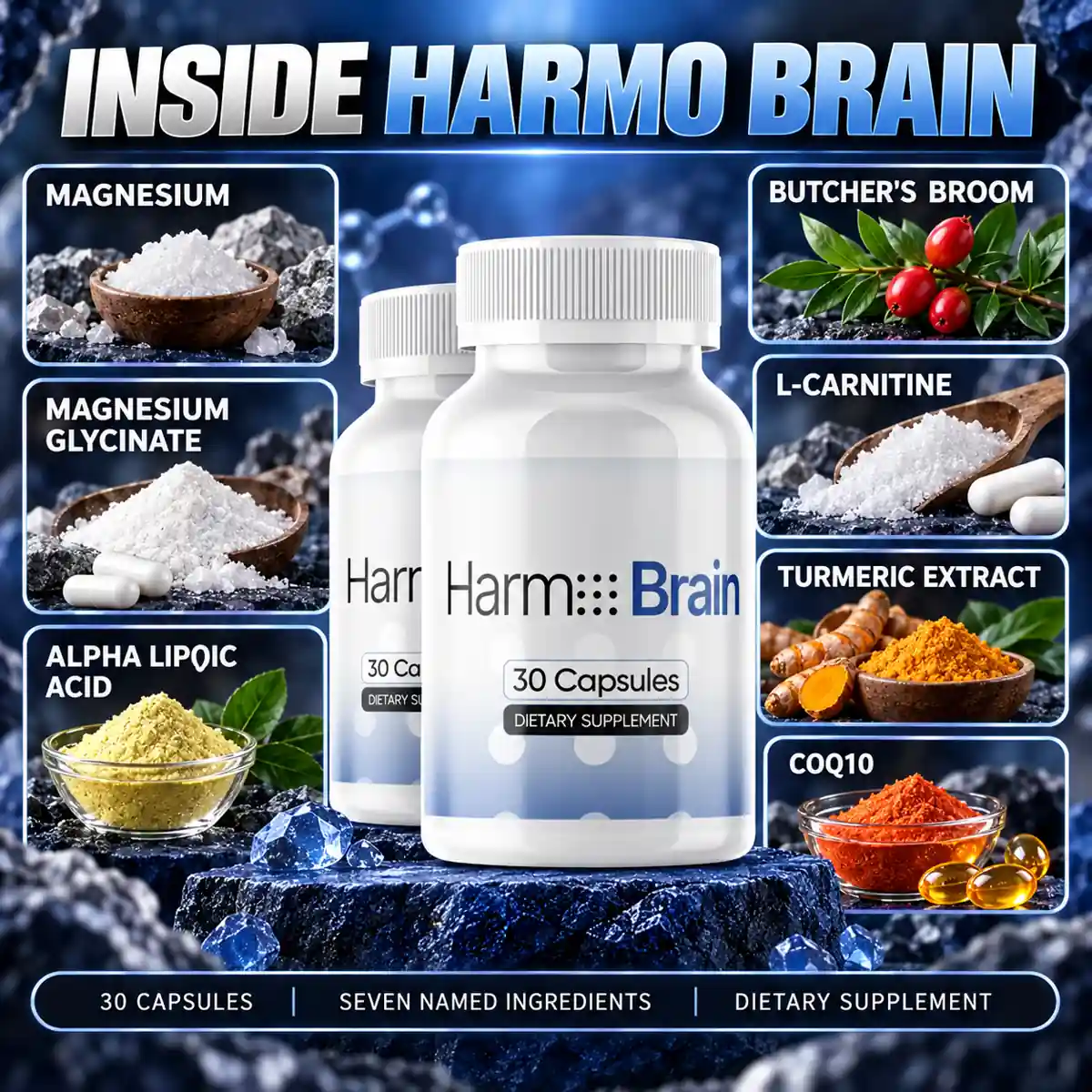
Butcher’s broom (Ruscus aculeatus) is a perennial shrub native to the Mediterranean and Black Sea regions (Pacula and colleagues). Extracts of its root and rhizome have been used in European vein products for more than 50 years, usually combined with hesperidin methyl chalcone and vitamin C (Allaert).
The single placebo-controlled trial most often cited gave a ruscus extract for 12 weeks to women with chronic venous insufficiency, 166 enrolled and 148 analysed, and lower-leg volume fell against placebo (Vanscheidt and colleagues). A 2025 review notes that much of the wider research used combination products, which makes effects hard to pin on ruscus alone (Pacula and colleagues).
So the trials measured the legs, not the head. On this label butcher’s broom is the circulatory half of the supplier’s description, and that is the honest size of its role: a well-known circulation botanical included alongside the mitochondrial three, with more on it in Circulation On A Brain Label.
Magnesium and turmeric in Harmo Brain
Two names sit outside both halves. One is the only ingredient with a printed amount; the other is a standardised extract of a familiar spice.
Magnesium, as glycinate
Magnesium is the only ingredient with its own printed amount: 80 mg, 19% of the Daily Value. It is a cofactor in more than 300 enzyme systems, including those behind energy production and nerve and muscle function (NIH ODS), and Kirkland and colleagues review its role in nerve transmission.
The glycinate form is magnesium bound to the amino acid glycine. In a small trial of 12 adults after ileal resection, overall absorption matched magnesium oxide, was higher in the poorest absorbers, and was better tolerated.
Turmeric, 95% curcuminoids
Turmeric is the ginger-family root that colours curry. The extract here is standardised to 95% curcuminoids, the compounds its research focuses on.
Curcumin taken by mouth is poorly absorbed and quickly broken down (Dei Cas and Ghidoni). The 18-month memory trial most often quoted used 90 mg of curcumin twice a day in a bioavailable formulation, in 40 adults aged 51 to 84 without dementia (Small and colleagues), which is a different product from a standard extract inside a shared blend.
Why Harmo Brain is one capsule a day
The label’s direction is short, and the way these nutrients are absorbed explains why a single daily capsule is enough.
A once-daily routine suits the way these nutrients behave. CoQ10 is slow in and slow out: levels peak hours after a dose and fall by half over about a day and a half (Bhagavan and Chopra), so yesterday’s capsule has not emptied out by the time today’s arrives. Magnesium is needed every day and most of it comes from food; a daily 80 mg tops up that supply rather than replacing it.
The practical rule follows from both: one capsule, at the same point in the day, every day. Consistency matters more than the hour you choose, and the how-to page sets out a routine that makes it stick.
What the evidence behind Harmo Brain covers
A clear picture includes the edges. This is where the evidence stands for the capsule as a whole.
What the formula stands on
- Each of the six materials is a nutrient or botanical with its own published record.
- Three of them have defined jobs inside mitochondria, the cell’s energy source.
- Magnesium is printed at a real share of the daily need: 80 mg, 19% DV.
- The routine is one capsule a day, simple enough to keep for weeks.
Where the record stops
- No trial of Harmo Brain as a finished product is cited on this website.
- The research on each name mostly used larger daily amounts than a 575 mg blend can hold.
- Several trials were run in people with a diagnosis, and their results stay with them.
- The seller’s artwork lines about focus and memory are the seller’s words.
Read the label analysis for how the 575 mg divides, and the ingredients page for the research amounts beside each name. Every amount in the research column is the amount a published study used. The Harmo Brain panel prints magnesium at 80 mg and the six-ingredient blend at 575 mg in total, so no research figure here describes what one capsule holds.
How Harmo Brain works: questions
How does Harmo Brain work?
It combines nutrients the body already uses to make energy. CoQ10, alpha lipoic acid and L-carnitine each have a job inside mitochondria, magnesium is a cofactor for hundreds of enzymes, butcher’s broom is a circulation botanical and turmeric extract is a standardised spice root. The supplier calls it a mitochondrial and circulatory formula.
How long does Harmo Brain take to work?
Most of this desk’s buyers who report a change put it at four to eight weeks of one capsule a day. The 60-day guarantee from purchase covers that window. See the results timeline.
Does Harmo Brain increase blood flow to the brain?
No study cited on this website measured that for this capsule. The butcher’s broom research measured the veins of the legs in women with chronic venous insufficiency, and it stays a finding about them.
Why is Harmo Brain taken only once a day?
The label directs one capsule daily. CoQ10 has a half-life of about 33 hours in pharmacokinetic studies, and magnesium is needed every day, so a steady daily capsule suits both. Do not take more than the label states.
Is Harmo Brain a stimulant?
No. None of its eleven ingredients is a stimulant, and there is no caffeine on the label. It works on the slow side, through daily nutrients, not a jolt.
Who writes the Harmo Brain science pages
How these pages are checked
- The bottle is the source. The six materials, the two amounts, the capsule count, the suggested use and the caution come from the printed label and its Supplement Facts panel. Contacts, the guarantee and the refund route come from this desk.
- Research amounts live in a column of their own, headed “What published research used or found”, beside a column that says what this label prints. No sentence here moves a number from the first into the second.
- Sources are cited against their own population. Where a trial was run in people with a diagnosis, the sentence says so and the result is not carried across to a healthy reader.
- Corrections change the date. Write to contact@Harmoebrain.com and the review date moves forward.
Why we say where we earn
Harmoebrain is the USA Authorized Harmo Brain Retailer named at the top of this page, and this website earns on orders placed through it. That is why the label arithmetic, the three-star review and the medication notes are printed here in full: they are where our interest and yours could pull apart.
Order support on +1 (302) 200-3480 handles tracking, changes and refunds and is never a way to place an order; orders go through the checkout only.
Sources on how the Harmo Brain ingredients work
- NIH Office of Dietary Supplements. Magnesium: Fact Sheet for Health Professionals. https://ods.od.nih.gov/factsheets/Magnesium-HealthProfessional/
- Kirkland AE, Sarlo GL, Holton KF. The Role of Magnesium in Neurological Disorders. Nutrients. 2018;10(6):730. PMID 29882776. https://pubmed.ncbi.nlm.nih.gov/29882776/
- Schuette SA, Lashner BA, Janghorbani M. Bioavailability of magnesium diglycinate vs magnesium oxide in patients with ileal resection. JPEN J Parenter Enteral Nutr. 1994;18(5):430-5. PMID 7815675. https://pubmed.ncbi.nlm.nih.gov/7815675/
- Linus Pauling Institute Micronutrient Information Center. Lipoic Acid. Oregon State University. https://lpi.oregonstate.edu/mic/dietary-factors/lipoic-acid
- Shay KP, Moreau RF, Smith EJ, et al. Alpha-lipoic acid as a dietary supplement: molecular mechanisms and therapeutic potential. Biochim Biophys Acta. 2009;1790(10):1149-60. PMID 19664690. https://pubmed.ncbi.nlm.nih.gov/19664690/
- Vanscheidt W, Jost V, Wolna P, et al. Efficacy and safety of a Butcher's broom preparation (Ruscus aculeatus L. extract) compared to placebo in patients suffering from chronic venous insufficiency. Arzneimittelforschung. 2002;52(4):243-50. PMID 12040966. https://pubmed.ncbi.nlm.nih.gov/12040966/
- Allaert FA. Combination of Ruscus aculeatus extract, hesperidin methyl chalcone and ascorbic acid: a comprehensive review of their pharmacological and clinical effects and of the pathophysiology of chronic venous disease. Int Angiol. 2016;35(2):111-6. PMID 26928296. https://pubmed.ncbi.nlm.nih.gov/26928296/
- Pacula W, Sowa I, Feldo M, et al. Current Insights into the Phytochemistry and Pharmacological Properties of Ruscus aculeatus. Molecules. 2025;30(22):4417. PMID 41302473. https://pubmed.ncbi.nlm.nih.gov/41302473/
- NIH Office of Dietary Supplements. Carnitine: Fact Sheet for Health Professionals. https://ods.od.nih.gov/factsheets/Carnitine-HealthProfessional/
- Dei Cas M, Ghidoni R. Dietary Curcumin: Correlation between Bioavailability and Health Potential. Nutrients. 2019;11(9):2147. PMID 31500361. https://pubmed.ncbi.nlm.nih.gov/31500361/
- Small GW, Siddarth P, Li Z, et al. Memory and Brain Amyloid and Tau Effects of a Bioavailable Form of Curcumin in Non-Demented Adults: A Double-Blind, Placebo-Controlled 18-Month Trial. Am J Geriatr Psychiatry. 2018;26(3):266-277. PMID 29246725. https://pubmed.ncbi.nlm.nih.gov/29246725/
- Hernandez-Camacho JD, Bernier M, Lopez-Lluch G, et al. Coenzyme Q10 Supplementation in Aging and Disease. Front Physiol. 2018;9:44. PMID 29459830. https://pubmed.ncbi.nlm.nih.gov/29459830/
- Bhagavan HN, Chopra RK. Coenzyme Q10: absorption, tissue uptake, metabolism and pharmacokinetics. Free Radic Res. 2006;40(5):445-53. PMID 16551570. https://pubmed.ncbi.nlm.nih.gov/16551570/
- Picard M, McEwen BS. Mitochondria impact brain function and cognition. Proc Natl Acad Sci U S A. 2014;111(1):7-8. PMID 24367081. https://pubmed.ncbi.nlm.nih.gov/24367081/
Try Harmo Brain for yourself
Three mitochondrial nutrients, a circulation botanical, 80 mg of magnesium and a turmeric extract in one daily capsule, with 60 days from purchase to decide.
Pack prices are shown on the seller’s checkout before you pay · 60-day money-back guarantee from purchase · lot HAR-26/HA-3723