Harmo Brain Official Website / Notebook / Research, read plainly
Research, read plainlyCirculation on a Brain Label: What Butcher's Broom Research Measured
One of the six names on this panel is a vein botanical. Here is who its best-known trial enrolled, what it measured, what it found, and how to read it on a brain energy label.
The short version
- The circulatory half. The supplier calls Harmo Brain a mitochondrial and circulatory formula. Butcher's broom is the circulatory name.
- Third by weight. It is listed third of six in the blend, after magnesium glycinate and alpha lipoic acid.
- Studied in the legs. Its best-known trial measured lower-leg volume in women with chronic venous insufficiency over 12 weeks.
- Often in combination. Much of its research used ruscus together with hesperidin methyl chalcone and vitamin C.
The plant behind the name
Butcher's broom, Ruscus aculeatus, is a perennial shrub of the asparagus family, native to the Mediterranean and Black Sea regions and naturalised in parts of Europe and North America (Pacula 2025). Its rhizome and root are the parts traditionally used, and the compounds that use is attributed to are steroidal saponins, ruscogenin and neoruscogenin above all, with flavonoids alongside.
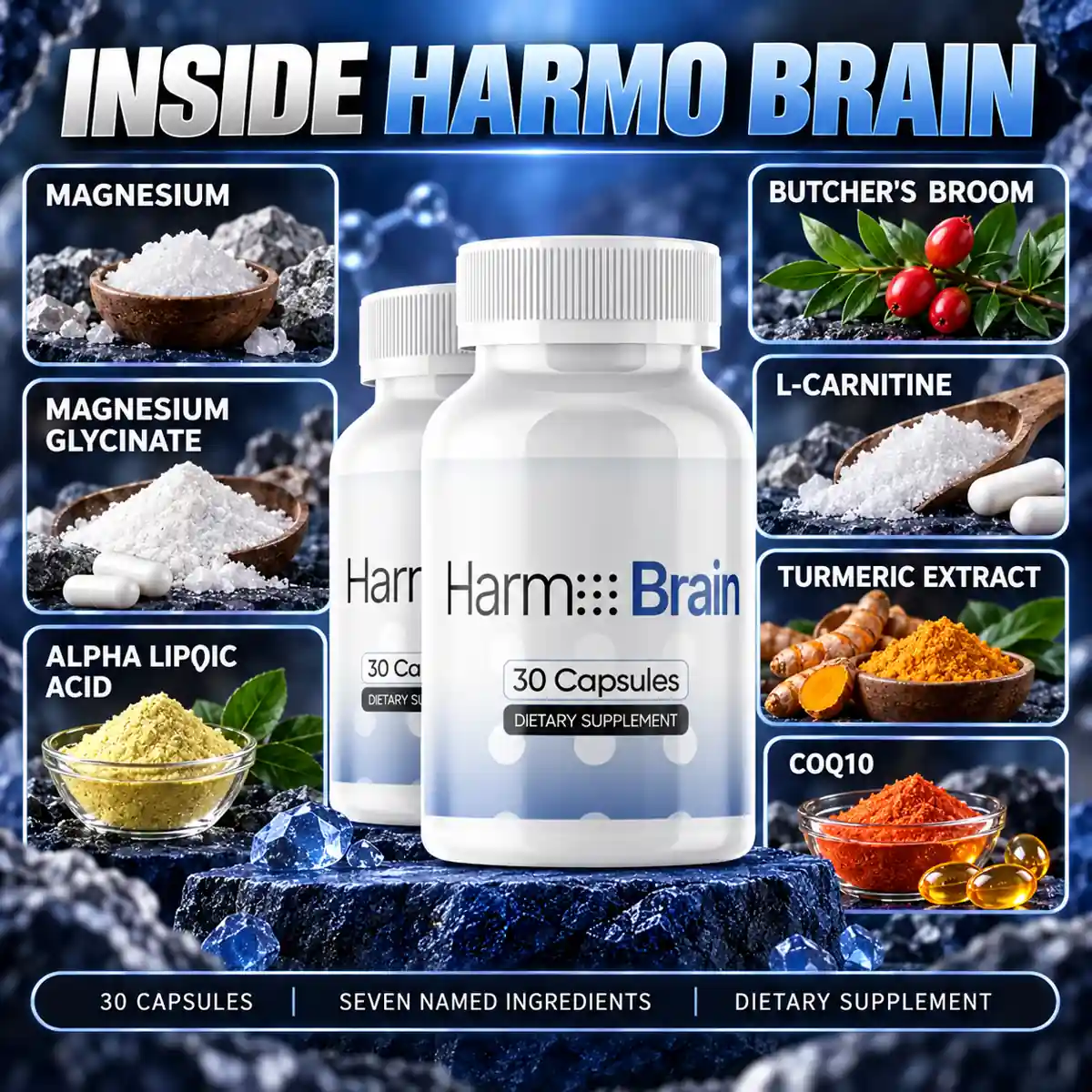
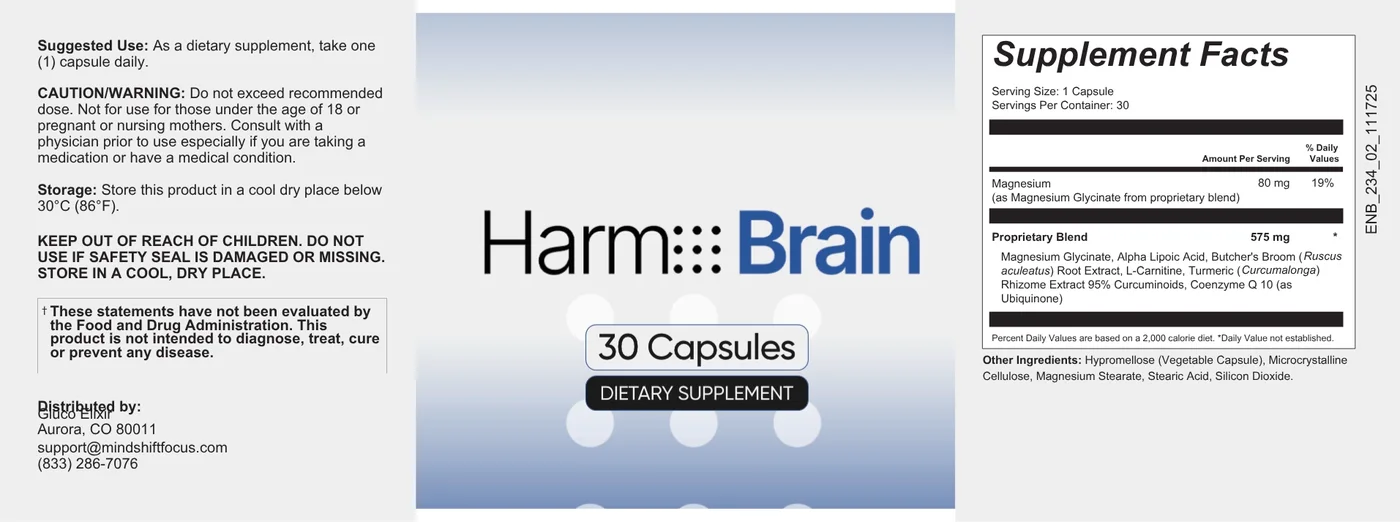
The Harmo Brain panel names it precisely: Butcher's Broom (Ruscus aculeatus) Root Extract. That tells you the species, the part of the plant and the fact that it is an extract rather than a ground powder. It does not tell you the extract ratio or the amount, because it sits inside the 575 mg proprietary blend.
Why a vein botanical is on a brain label
The answer is in the supplier's own description. It calls Harmo Brain a mitochondrial and circulatory formula. Three of the six names serve the first half: alpha lipoic acid, L-carnitine and CoQ10 all take part in how mitochondria turn fuel into energy. Butcher's broom is the second half, and it is the only circulatory name on the panel.
The reasoning behind pairing the two is easy to follow. The brain is among the most energy-hungry organs in the body and depends on its mitochondria (Picard and McEwen), and blood is what brings those mitochondria their fuel and oxygen. The research question is narrower: what has butcher's broom actually been shown to do, in whom, and where in the body?
Venous insufficiency, in plain words
Veins carry blood back to the heart, and in the legs they work against gravity. Small one-way valves inside them stop the blood from sliding back down. When those valves weaken, blood pools in the lower legs, and the result is heaviness, aching and swelling around the ankles. That is chronic venous insufficiency.
It explains what the research on butcher's broom measured and why. Swelling can be measured as the volume of the lower leg, and symptoms can be scored, so those became the outcomes. Both describe the veins of the legs.
Who the trial enrolled
The trial most often cited for butcher's broom was a multi-centre, double-blind, placebo-controlled study run in Germany and published in 2002 (Vanscheidt 2002). It enrolled 166 women with chronic venous insufficiency, and 148 of them, aged 30 to 89, were analysed. They had lived with the condition for about fifteen years on average, and it was graded CEAP class 3 or 4 on the standard scale for vein disease: swelling and skin changes, short of the open ulcers of the most severe classes.
They took a ruscus rhizome extract in capsules at the daily dose recommended by the German monograph, or a placebo, for 12 weeks. That is the population every result below belongs to: women with a long-standing, diagnosed venous condition, on a monograph dose of a single ruscus product.
| Question | Answer in the 2002 trial |
|---|---|
| Who | 166 women with chronic venous insufficiency enrolled, 148 analysed, aged 30 to 89 |
| What they took | A ruscus rhizome extract at the German monograph's daily dose, or placebo |
| For how long | 12 weeks |
| Main measure | The change in lower-leg volume |
What it measured, and what it found
The main outcome was lower-leg volume, measured over the 12 weeks. Against placebo, leg volume fell by about 16.5 ml at week 8 and 20.5 ml at week 12. Ankle and lower-leg circumference also fell, and by week 12 the women on the extract reported less of two symptoms, heavy tired legs and a sensation of tension.
Tolerability was rated good to very good in both groups. Of 48 adverse events across the whole trial, 22 were in the ruscus group, and one of those was judged possibly related to the extract, with the investigators rating that link unlikely.
A solid, specific result: less swelling and fewer leg symptoms in women with a diagnosed venous condition, on a monograph dose, over 12 weeks. Every word of that sentence limits where the result applies.
Harmo Brain: the mitochondrial and circulatory formula
Butcher's broom root extract is third of six names in a 575 mg blend, beside 80 mg of magnesium as glycinate. One capsule a day, 60-day money-back guarantee.
Order Harmo BrainThe combination problem
Much of the rest of the research on ruscus did not test it alone. A review of its use in chronic venous disease describes a combination of ruscus extract with hesperidin methyl chalcone and ascorbic acid, used in some European countries for more than 50 years (Allaert 2016).
The 2025 review draws the consequence: because so many investigations used complex formulations of that kind, it is difficult to attribute the observed effects to Ruscus aculeatus alone, and further well-designed studies are needed (Pacula 2025).
| Source | Who or what | What it tells this label |
|---|---|---|
| Vanscheidt 2002 | 148 women with chronic venous insufficiency, 12 weeks | The extract's best-documented effect is in the legs |
| Allaert 2016 | Review of a three-part vein combination | Most of the long use is of a combination |
| Pacula 2025 | Review of chemistry and pharmacology | Effects are hard to attribute to ruscus alone |
How it is thought to act
The vein research describes two actions. The first is on the veins themselves: ruscus extract has a venoconstrictive effect, helping the vein wall hold its tone. The second is on the smallest vessels, where raised pressure in the veins disturbs the microcirculation; the combination review describes preclinical studies of both, and of an effect on the lymphatics (Allaert 2016).
Both actions are described in the context of venous disease, and most of the work behind them is preclinical or used the three-part combination. They explain why the plant is used for heavy, swollen legs. They are not a mechanism for anything above the neck, and no source cited here proposes one.
What the research does not reach
None of these studies measured blood flow to the brain, memory or concentration. That is not a flaw in them; they asked a different question, about veins in the legs, and answered it.
It does mean the step from a vein botanical to a brain label is the supplier's reasoning about the formula, not a finding. Read that way, the broom is exactly what the supplier calls it: the circulatory half of the formula, included for the role circulation plays, not a demonstrated route to the brain.
If circulation is the part of the formula that appeals to you, that is the gap to keep in view: the evidence is good, specific and about the legs.
Reading it on the Harmo Brain panel
Proprietary blends list their ingredients heaviest first, under the federal rule for Supplement Facts panels (21 CFR 101.36). Butcher's broom is third of six, so it outweighs L-carnitine, turmeric and CoQ10 and is outweighed by magnesium glycinate and alpha lipoic acid.
The magnesium glycinate that supplies 80 mg of magnesium takes most of the 575 mg, which leaves the other five names a small shared remainder; the working is in six ingredients share 575 mg. The trial dose was the monograph's daily amount of one extract, and the Harmo Brain panel gives the broom a share of the blend rather than an amount, so the two cannot be matched milligram for milligram.
Five questions for any circulation ingredient
- Which part of the body did its trials measure?
- Was it tested alone, or in a combination product?
- Who took part, and did they have a diagnosis?
- What dose did the trial use, and does the label print an amount?
- Does the label call it circulatory, or claim a result?
Run on this label, the answers are: the legs; mostly in combination; women with chronic venous insufficiency; a monograph dose, against a share of a blend; and circulatory, in the supplier's own words. Those five answers are the fairest one-paragraph account of butcher's broom on a Harmo Brain capsule.
The other five names are introduced on the ingredients page, and the how it works page sets out how the two halves of the formula are meant to fit together.
Harmo Brain is a dietary supplement, not a medicine. Nothing in this post describes it as treating, preventing or slowing any condition. A change in memory, energy or concentration that worries you is a reason to be assessed, not a reason to start a capsule.
Sources cited in this article
- Vanscheidt W, Jost V, Wolna P, et al. Efficacy and safety of a Butcher's broom preparation (Ruscus aculeatus L. extract) compared to placebo in patients suffering from chronic venous insufficiency. Arzneimittelforschung. 2002;52(4):243-50. PMID 12040966. https://pubmed.ncbi.nlm.nih.gov/12040966/
- Allaert FA. Combination of Ruscus aculeatus extract, hesperidin methyl chalcone and ascorbic acid: a comprehensive review of their pharmacological and clinical effects and of the pathophysiology of chronic venous disease. Int Angiol. 2016;35(2):111-6. PMID 26928296. https://pubmed.ncbi.nlm.nih.gov/26928296/
- Pacula W, Sowa I, Feldo M, et al. Current Insights into the Phytochemistry and Pharmacological Properties of Ruscus aculeatus. Molecules. 2025;30(22):4417. PMID 41302473. https://pubmed.ncbi.nlm.nih.gov/41302473/
- Picard M, McEwen BS. Mitochondria impact brain function and cognition. Proc Natl Acad Sci U S A. 2014;111(1):7-8. PMID 24367081. https://pubmed.ncbi.nlm.nih.gov/24367081/
- Code of Federal Regulations, Title 21, Section 101.36. Nutrition labeling of dietary supplements. https://www.ecfr.gov/current/title-21/chapter-I/subchapter-B/part-101/subpart-C/section-101.36