Harmo Brain Official Website / Notebook / Sleep, movement and water
Everyday leversSleep, Movement and Water: What Research Says to Settle Before Any Brain Capsule Gets the Credit
Every label in this category ends with a version of the same sentence: food, sleep and activity still matter. It is easy to read past. Here it is treated as the main event, because the research on those three things is larger, older and firmer than the research on any capsule.
The short version
- Sleep first. One night of restricted sleep reliably dulls sustained attention. Across 44 studies, reaction times and lapses worsened, while working memory did not show a significant change.
- Movement has the firmest evidence. An umbrella review of 133 systematic reviews found exercise improved general cognition, memory and executive function, and that even light activity helped.
- Water matters at the margin. A meta-analysis found dehydration impairs attention and executive tasks, mostly when body water loss passes about 2% of body mass.
- Food patterns are humbling. A three-year US trial of the MIND diet found no significant cognitive difference from a control diet that also cut calories.
- The practical point. If you start a capsule and change your sleep or exercise in the same fortnight, you cannot tell which one did anything.
Why start with the boring things
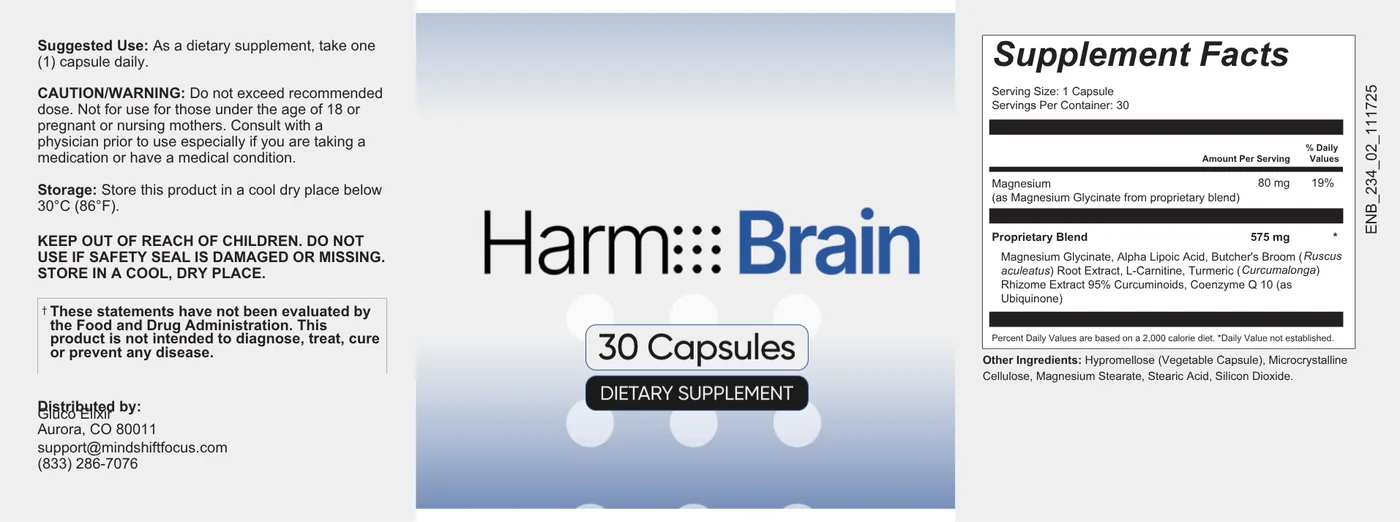
The Harmo Brain panel prints 80 mg of magnesium and a 575 mg blend of six names. The results disclaimer on this website says what every honest label says: individual results vary, and food, sleep and activity still matter. That sentence is not filler. It describes the biggest source of noise in any attempt to judge a capsule.
Think about what "judging a capsule" involves. You take it every day for a few weeks and ask whether your focus or memory feels different. But your focus and memory also move with how you slept last night, whether you walked today, how much you drank, whether you are worried about something, whether it is Monday. Those swings are large. A supplement that supplies 80 mg of magnesium and a shared remainder of five other materials is being asked to show up against a background that can move a lot more than that from one day to the next.
So this article does something unusual for a supplement website. It sets out what research has measured for sleep, exercise, water and food, so you can see how big those effects are, and it turns that into a plan for trying the capsule fairly. It does not claim the capsule does anything more than what its label says. It is about giving whatever the capsule does a chance to be seen.
Sleep: the fastest way to lose focus
The best-known summary of short-term sleep loss is a 2010 meta-analysis of 70 articles containing 147 cognitive tests. It found effects ranging from small and not significant, for accuracy on reasoning tasks, to large: lapses in simple attention had an effect size of about 0.78 (Lim and Dinges 2010). In plain terms, when people are kept awake, the thing that suffers most is the ability to stay on a simple task without drifting.
A 2024 review looked at a milder situation than staying up all night: one night of sleep restricted to between two and six hours. Across 44 studies, people felt markedly sleepier, and sustained attention got worse, with longer reaction times and more lapses. Perhaps surprisingly, the review found no significant effects on choice reaction time, cognitive throughput, working memory or inhibitory control (Wüst 2024). Sustained attention is the ability behind everyday tasks like driving, reading a long email or holding a train of thought through a meeting. It is also the part of "focus" that a brain supplement is most likely to be judged on.
Sleep also does something for memory beyond keeping you awake for the test. A widely cited review describes evidence that sleep contributes to memory consolidation, the process by which new learning is stabilised (Walker and Stickgold 2004). You do not need the details to take the practical point: if a week of poor nights coincides with the first week of a new capsule, the week will be dominated by the nights.
Movement: the most dependable finding
Exercise has the strongest evidence of the everyday levers. A 2018 systematic review of 39 randomised trials in adults over 50, 36 of them pooled in the meta-analysis, found that exercise improved cognitive function, with a pooled effect of 0.29 (95% confidence interval 0.17 to 0.41). Aerobic exercise, resistance training, multicomponent training and tai chi all showed benefit, and sessions of 45 to 60 minutes at moderate intensity or above were associated with the gains (Northey 2018).
A 2025 umbrella review pulled together 133 systematic reviews covering 2,724 trials and more than 258,000 participants. Exercise significantly improved general cognition, memory and executive function, and the authors concluded that even light-intensity exercise helped. Effects were generally larger for low- and moderate-intensity programmes, and shorter programmes of one to three months had some of the largest effects on general cognition and memory (Singh 2025).
| Review | What it covered | Headline result |
|---|---|---|
| Northey 2018 | 39 randomised trials in adults over 50 (36 pooled) | Pooled effect on cognitive function 0.29 (95% CI 0.17 to 0.41) |
| Singh 2025 | 133 systematic reviews, 2,724 trials, 258,279 participants | General cognition 0.42, memory 0.26, executive function 0.24 |
| Both | Different intensities and types | Benefits at moderate intensity; the newer review also found benefit at light intensity |
Effect sizes are standardised mean differences, which put different tests on one scale. They describe average trial results, not what any one person will notice.
Compare those numbers with the research on the ingredients in a brain capsule. The exercise evidence pools thousands of trials and hundreds of thousands of people; the evidence for the individual materials on the Harmo Brain label is a handful of small trials, several in people with a diagnosis. That does not make a capsule pointless. It does mean that a walk is a much better-supported bet.
Harmo Brain, once you have the basics steady
One capsule a day, 30 to a bottle, with 60 days from purchase to decide. Two bottles cover the whole window.
Order Harmo BrainWater: a small effect with a clear threshold
Dehydration is the easiest of the levers to fix and the easiest to overrate. A 2018 meta-analysis of 33 studies, with 413 participants, found that dehydration impaired cognitive performance by a small but significant amount overall, with an effect of about 0.21. The impairment was largest for attention tasks, at about 0.52, and it was worse when body mass loss passed 2% than when it stayed below that (Wittbrodt 2018).
Read that carefully. The studies produced dehydration on purpose, by exercise, heat or fluid restriction, so they say something about a hot day of manual work or a long run more than about a normal desk day with a glass at hand. So the honest reading is not "drink more and think better". It is "do not let an avoidable dry spell, such as a long morning without a drink, pass as a focus problem". If you catch yourself at 3pm with a headache and a dry mouth, that is a data point about the day, not about the capsule.
Food: the humbling result
Diet is the lever people most want to believe in and the one whose trials have been most sobering. In a two-site randomised trial, 604 older adults without cognitive impairment, all with a family history of dementia, a body-mass index over 25 and a suboptimal diet, followed either the MIND diet or a control diet with mild calorie restriction for three years. Cognition improved in both groups, by 0.205 standardised units in the MIND group and 0.170 in the control group, and the difference was not significant (0.035; 95% confidence interval -0.022 to 0.092). Brain scan measures were also similar in the two groups (Barnes 2023).
Two lessons come out of that. First, even a carefully designed diet with strong observational backing did not separate from a sensible control diet over three years. So no single food pattern should be treated as a proven fix. Second, both groups improved, which is a reminder of how much people improve simply by taking part in a structured programme. That is exactly the effect a capsule trial has to contend with.
A note on capsules and diet together. Cochrane's review of vitamin and mineral supplementation for cognitively healthy people in mid and late life, covering 28 studies and more than 83,000 participants, did not find evidence that any strategy had a meaningful effect on cognitive decline or dementia, though it said the evidence did not permit definitive conclusions (Rutjes 2018). Magnesium is a mineral, and this review is about supplementation of that kind. Its conclusion is a reason for humility rather than a verdict on any one capsule, and it is part of why the label and this website do not promise memory or focus outcomes.
How to try a capsule without fooling yourself
If you decide to try Harmo Brain, the aim is a trial in which the capsule is the only thing that changes. The research above suggests four habits.
- Write a baseline first. Before the first capsule, note for a week or so how many hours you sleep, how often you are active, what and when you drink, and how your afternoons feel in a sentence. Simple beats elaborate.
- Change one thing at a time. If you also plan to start running, cut back on coffee or move your bedtime, do that first and let it settle for a fortnight before the capsule starts.
- Score the same three moments. Pick mid-morning, mid-afternoon and evening, and rate focus from 1 to 5 at the same times each day. Small numbers on a calendar are easier to trust than a memory of how the month felt.
- Look for trends, not days. One bad night can flatten a good week. Compare the average of your first fortnight with the average of weeks four to eight.
The fair-trial plan lays this out day by day across the 60-day guarantee window, and the results timeline explains the weeks buyers describe. What matters here is the order of operations: steady the basics, then add the capsule, then decide.
The things that quietly muddy a trial
Beyond the four levers, a few ordinary events can swamp a small signal, and none of them has anything to do with the capsule. It helps to name them before you start, because a note in your log on the day they happen saves an argument with yourself later.
- Illness. A cold or a stomach bug flattens concentration for days. Mark those days and leave them out of your averages.
- Travel and time zones. A flight or a week of night shifts is a sleep experiment you did not intend to run. Do not start a capsule the week before one.
- Alcohol. A late night with drinks changes the next day's sleep and mood as well as the hangover itself. Note it rather than trying to remember it.
- Big changes in routine. A new job, a house move, exams or a family event all change stress and sleep. If one is coming, wait.
- Other new products. A new medicine, a new supplement or a change in your morning coffee all change the picture. Introduce them a fortnight apart, and tell your prescriber about any new supplement.
A worked example
Imagine someone who sleeps about six hours on weeknights, sits most of the day and has a coffee at four in the afternoon. She hears about a brain capsule and starts it on a Monday. In week two she also joins a lunchtime walking group, because a colleague asked. By week four her afternoons feel better. What caused that?
She cannot tell. The walking group is the better-supported explanation, on the evidence above, and the extra sleep she gets when the walks make her tired at night is the second. The capsule might have contributed, but nothing in her notes can show it. Now run it the other way. She joins the walking group first, keeps a simple log, and gives it a fortnight. Then she starts the capsule and changes nothing else for four weeks. If her afternoon numbers rise further after the capsule starts, she has a small but real piece of evidence. If they do not, she has learned something equally useful, and she still has 60 days from purchase to return it.
That is not a guarantee of clarity. A daily score out of five is a crude instrument, and expectation colours everything. But it is a great deal better than the alternative, and it costs a few lines in a notebook.
The one line that matters most
Sleep, movement and water are not glamorous, and no label can sell them. But the research is consistent about which levers move attention and memory the most, and it is not the ones that come in capsules. If your sleep is short, your week is sedentary or you rarely drink before the afternoon, fixing that is likely to change how you feel by more than anything on the Harmo Brain panel could, and it will make any trial of the capsule far easier to read.
The label asks adults who take medicine or have a medical condition to consult a physician before use, and it rules out anyone under 18 and anyone pregnant or nursing. If a change in memory or concentration is what prompted you to look for a capsule, the first step is a conversation with a clinician, not a purchase. The side effects and safety page lists what to raise, and the magnesium article covers the one ingredient with an amount of its own.
Harmo Brain is a dietary supplement, not a medicine, and nothing in this article describes it as treating, preventing or slowing any condition. Persistent trouble with sleep, memory or concentration is a reason to see a clinician. Treatable things, including depression, medicine side effects and thyroid, liver or kidney problems, can affect memory, and a capsule is not the way to find out.
Sources cited in this article
- National Center for Complementary and Integrative Health. 7 Things To Know About Dietary Supplements for Cognitive Function, Dementia, and Alzheimer's Disease. https://www.nccih.nih.gov/health/tips/things-to-know-about-dietary-supplements-for-cognitive-function-dementia-and-alzheimers-disease
- Lim J, Dinges DF. A meta-analysis of the impact of short-term sleep deprivation on cognitive variables. Psychol Bull. 2010;136(3):375-89. PMID 20438143. https://pubmed.ncbi.nlm.nih.gov/20438143/
- Wüst LN, Capdevila NC, Lane LT, Reichert CF, Lasauskaite R. Impact of one night of sleep restriction on sleepiness and cognitive function: A systematic review and meta-analysis. Sleep Med Rev. 2024;76:101940. PMID 38759474. https://pubmed.ncbi.nlm.nih.gov/38759474/
- Walker MP, Stickgold R. Sleep-dependent learning and memory consolidation. Neuron. 2004;44(1):121-33. PMID 15450165. https://pubmed.ncbi.nlm.nih.gov/15450165/
- Northey JM, Cherbuin N, Pumpa KL, Smee DJ, Rattray B. Exercise interventions for cognitive function in adults older than 50: a systematic review with meta-analysis. Br J Sports Med. 2018;52(3):154-160. PMID 28438770. https://pubmed.ncbi.nlm.nih.gov/28438770/
- Singh B, Bennett H, Miatke A, Dumuid D, Curtis R, Ferguson T, et al. Effectiveness of exercise for improving cognition, memory and executive function: a systematic umbrella review and meta-meta-analysis. Br J Sports Med. 2025;59(12):866-876. PMID 40049759. https://pubmed.ncbi.nlm.nih.gov/40049759/
- Wittbrodt MT, Millard-Stafford M. Dehydration Impairs Cognitive Performance: A Meta-analysis. Med Sci Sports Exerc. 2018;50(11):2360-2368. PMID 29933347. https://pubmed.ncbi.nlm.nih.gov/29933347/
- Barnes LL, Dhana K, Liu X, Carey VJ, Ventrelle J, Johnson K, et al. Trial of the MIND Diet for Prevention of Cognitive Decline in Older Persons. N Engl J Med. 2023;389(7):602-611. PMID 37466280. https://pubmed.ncbi.nlm.nih.gov/37466280/
- Rutjes AW, Denton DA, Di Nisio M, Chong LY, Abraham RP, Al-Assaf AS, et al. Vitamin and mineral supplementation for maintaining cognitive function in cognitively healthy people in mid and late life. Cochrane Database Syst Rev. 2018;12(12):CD011906. PMID 30556597. https://pubmed.ncbi.nlm.nih.gov/30556597/