Harmo Brain Official Website / Notebook / Alpha Lipoic Acid
Ingredient in depthAlpha Lipoic Acid in Harmo Brain: The Second Name in the Blend
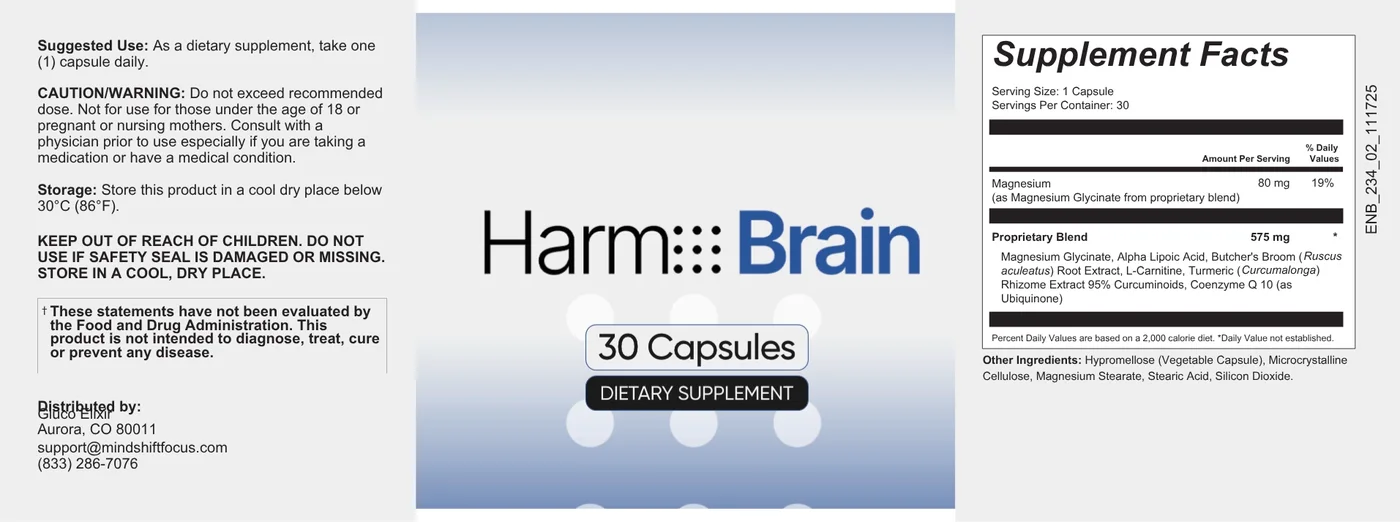
Alpha lipoic acid is the second of six materials in the Harmo Brain 575 mg proprietary blend, listed straight after magnesium glycinate. The body makes it in small amounts and uses it as a cofactor for enzyme complexes inside mitochondria, the parts of a cell that turn food into usable energy. The label prints no separate amount for it and does not say which form, R or S, is used.
The short version
- Second of six. Heavier than butcher's broom, L-carnitine, turmeric and CoQ10.
- A mitochondrial name. One of three on the label, with L-carnitine and CoQ10.
- No form printed. The panel reads Alpha Lipoic Acid, with no R or S.
- One medicine note. It can lower blood sugar, so diabetes medicines are worth raising first.
What alpha lipoic acid is
Alpha lipoic acid, often shortened to ALA or simply lipoic acid, is a small sulphur-containing compound. Your body makes it in small amounts, and food supplies a little more. Inside cells it works as a cofactor, a helper molecule, for enzyme complexes in the mitochondria, according to the Linus Pauling Institute.
That is why it appears on a label like this one. The supplier describes Harmo Brain as a mitochondrial and circulatory formula, and alpha lipoic acid is one of the three mitochondrial names, beside L-carnitine and coenzyme Q10. Butcher's broom is the circulatory name, and magnesium and turmeric sit in the blend as themselves.
Where alpha lipoic acid sits on the HarmoBrain label
The Supplement Facts panel prints two amounts: magnesium at 80 mg (19% DV) and a 575 mg proprietary blend. The blend lists six names in order of weight, as the federal labelling rule requires:
- Magnesium Glycinate, the source of the printed 80 mg of magnesium.
- Alpha Lipoic Acid, the subject of this article.
- Butcher's Broom (Ruscus aculeatus) Root Extract.
- L-Carnitine.
- Turmeric (Curcuma longa) Rhizome Extract 95% Curcuminoids.
- Coenzyme Q10 (as Ubiquinone).
Second place means alpha lipoic acid weighs more than each of the four names after it, and less than magnesium glycinate. It does not give a milligram figure. The label leaves that inside the blend, and this website does not guess it. The 575 mg blend article shows how much room magnesium glycinate leaves for the other five.
R vs S: which form of alpha lipoic acid?
Alpha lipoic acid comes in two mirror-image forms, called R and S. They have the same atoms arranged as left and right hands. The R form is the one the body makes and uses in its enzymes. Many supplements use a mix of the two, and some use R alone.
The Harmo Brain panel reads simply Alpha Lipoic Acid. It names no form, so the label does not tell you whether the capsule holds R, S or a mix. If the form matters to you, that is a fair question to keep in mind when you compare labels: a panel that names the form tells you more than one that does not.
What the label does tell you is the order of weight, and that alpha lipoic acid shares the 575 mg with five other materials in one capsule a day. Every name is set out with its own card on the ingredients page.

Six materials, one capsule
Alpha lipoic acid sits second in a 575 mg blend with magnesium glycinate, butcher's broom, L-carnitine, turmeric and CoQ10. One capsule a day, with 60 days from purchase to decide.
Order Harmo BrainWhat the research used, and what the label prints
The largest body of research on oral alpha lipoic acid comes from people with diabetic polyneuropathy, a nerve condition linked to diabetes. A 2023 meta-analysis by Hsieh and colleagues pooled ten trials with 1,242 people, at 600, 1,200 and 1,800 mg a day.
| What published research used | What this label prints | |
|---|---|---|
| Amount | 600, 1,200 and 1,800 mg a day | A share of the 575 mg blend, not printed |
| People | 1,242 people with diabetic polyneuropathy, across ten trials | Adults 18 and over |
| Product | Alpha lipoic acid on its own | One of six materials in one capsule |
Two things follow. First, the trial amounts are research amounts. The whole blend is 575 mg, so the capsule is a daily combination, not a trial dose of any one material. Second, those trials were run in people with a diagnosis, and their results belong to that group. This website does not carry them across to a healthy reader, and it does not describe Harmo Brain as doing anything for a nerve condition.
Blood sugar, insulin and who should ask first
Lipoic acid can lower blood sugar, so blood glucose is watched when it is added alongside insulin or diabetes tablets, as the Linus Pauling Institute notes. A published case also describes a rare insulin autoimmune syndrome in one woman, which started two weeks after she began taking alpha lipoic acid and resolved over fifteen months.
- Anyone on insulin or other diabetes medicines: speak to the person who manages your diabetes first.
- Anyone already taking another product with lipoic acid in it: count both labels together.
- Anyone under 18, pregnant or nursing: the label rules the capsule out.
- Anyone on any medication or with a medical condition: the label asks you to consult a physician first.
NCCIH's advice on using supplements wisely puts telling your health care providers what you take near the top of its list. The other medicines worth raising are tied to their ingredients on the side effects and safety page and in the interactions article.
Alpha lipoic acid with CoQ10 and L-carnitine
Some people search for alpha lipoic acid together with CoQ10, L-carnitine and butcher's broom, because they have seen those names side by side on a label. On the Harmo Brain panel they are all inside the same 575 mg blend: alpha lipoic acid second, butcher's broom third, L-carnitine fourth and CoQ10 sixth.
Each of the three mitochondrial names has a plain job description. L-carnitine carries fatty acids into mitochondria so they can be burned for energy. CoQ10, here as ubiquinone, is a link in the chain that turns fuel into usable energy. Alpha lipoic acid helps the enzyme complexes that feed that chain. Together they are what the supplier means by the word mitochondrial.
None of this is a promise about how one capsule will make you feel. Most of the buyers here who report a change place it at four to eight weeks of one capsule a day, and results vary. The 60-day money-back guarantee, counted from purchase, leaves room to judge it in your own routine.
Alpha lipoic acid questions
How much alpha lipoic acid is in Harmo Brain?
The label does not print a separate amount. Alpha lipoic acid is second of six names inside the 575 mg proprietary blend, which the labelling rule allows to be shown as one total.
Is the alpha lipoic acid in HarmoBrain the R form?
The panel reads Alpha Lipoic Acid and names no form, so the label does not say whether it is R, S or a mix of the two.
Can I take Harmo Brain if I use insulin?
Check with the person who manages your diabetes first. Lipoic acid can lower blood sugar, and NCCIH lists insulin among CoQ10's possible interactions.
Keep reading: All six ingredients · How Harmo Brain works · The printed panel · Medicines to mention · Butcher's broom research.
Harmo Brain is a dietary supplement, not a medicine. Nothing in this post describes it as a remedy for any condition. A change in memory, energy or concentration that worries you is a reason to be assessed by a doctor, not a reason to start a capsule.
Sources cited in this article
- Linus Pauling Institute Micronutrient Information Center. Lipoic Acid. Oregon State University. https://lpi.oregonstate.edu/mic/dietary-factors/lipoic-acid
- Hsieh RY, Huang IC, Chen C, et al. Meta-analysis and systematic review of oral alpha-lipoic acid in diabetic polyneuropathy. Nutrients. 2023;15(16):3634. PMID 37630823. https://pubmed.ncbi.nlm.nih.gov/37630823/
- Cappellani D, Sardella C, Campopiano MC, et al. Spontaneously remitting insulin autoimmune syndrome in a patient taking alpha-lipoic acid. Endocrinol Diabetes Metab Case Rep. 2018;2018:EDM180122. PMID 30532997. https://pubmed.ncbi.nlm.nih.gov/30532997/
- National Center for Complementary and Integrative Health. Using Dietary Supplements Wisely. National Institutes of Health. https://www.nccih.nih.gov/health/using-dietary-supplements-wisely